
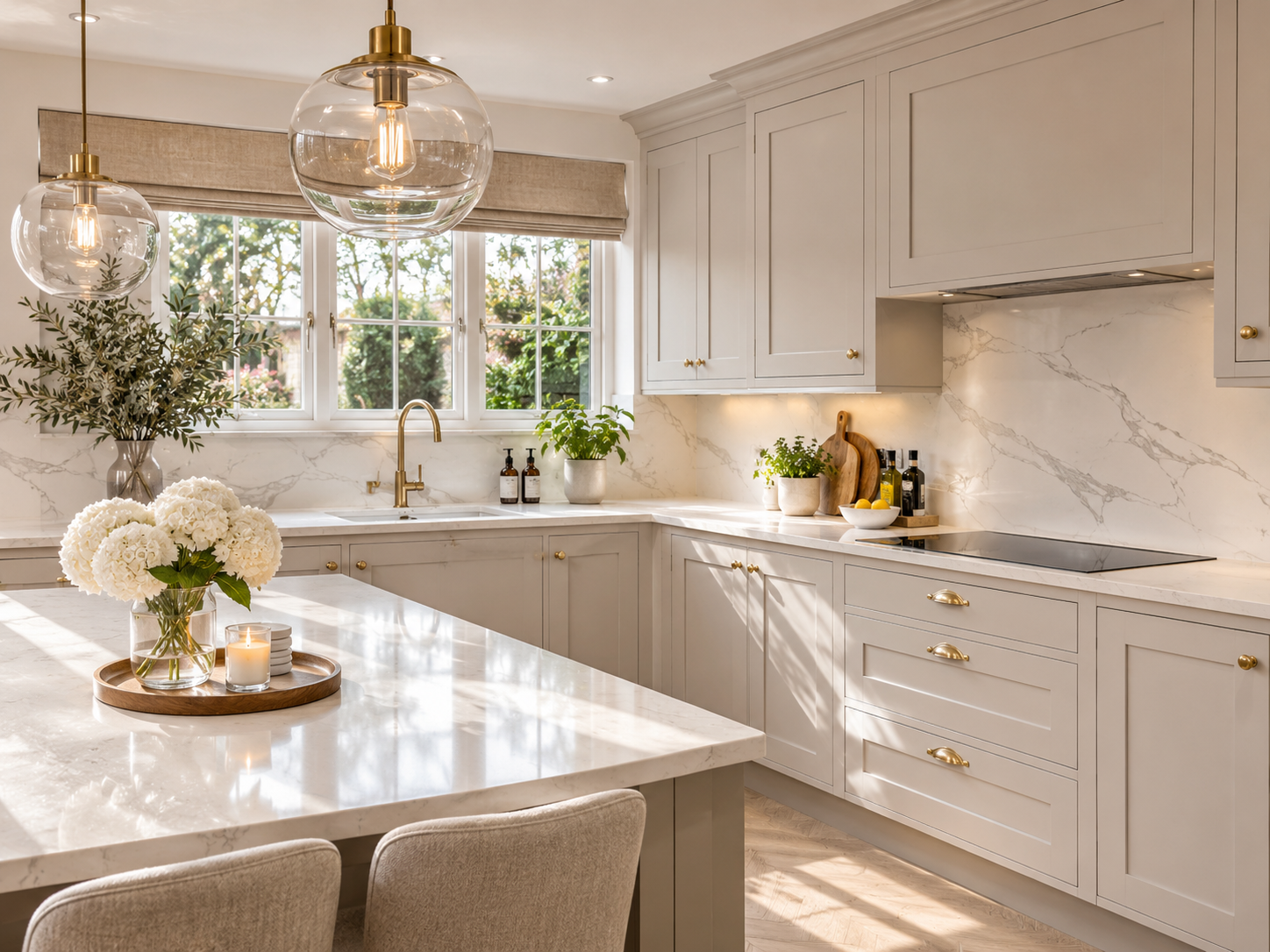
The splashback is one of the most defining details in any kitchen. It frames the hob, catches the light behind the worktop, and ties the whole design together. However, the way homeowners are approaching splashbacks has changed dramatically over the last few years. Traditional tiles have quietly lost ground to full-height quartz, and for good reason.
At Modern Worktops, we fabricate quartz, marble, granite, and porcelain worktops for luxury homes across Hertfordshire, Essex, and London. We have fitted hundreds of splashbacks in different materials and styles. We have put together the following guide to help you decide which approach is right for your kitchen.
What is a Full-Height Quartz Splashback?
A full-height quartz splashback is a single, continuous slab of quartz that runs from the worktop up the wall. Sometimes it stops at the underside of the wall units. Equally, it can run all the way to the ceiling behind a statement hob or extractor. The stone typically matches the worktop, so the veining flows seamlessly from one surface to the other.
It replaces the tiled area entirely with a single piece of engineered stone. The result is clean, continuous, and impressively luxurious.

What are Tiled Splashbacks?
Tiled splashbacks are the traditional choice. They can be ceramic, porcelain, metro, natural stone or glass. They come in every size and finish imaginable, from large-format slabs that mimic marble to small mosaic patterns that add texture and colour.
Tiles have been the default for decades, and for good reason. However, luxury kitchen design has shifted, and tiles are no longer the only serious option.

Style and Visual Impact
This is where full-height quartz truly earns its place. A single slab of Calacatta or Arabescato running the full height of the wall creates a dramatic, uninterrupted feature. The veining flows. The light catches the polish beautifully. Above all, it reads as one considered design decision rather than a grid of smaller pieces.
Tiles have grout lines, and joins can break up the visual flow. Likewise, the pattern repeats in a way that quartz slabs simply do not. For homeowners chasing that magazine-worthy, bespoke finish, full-height quartz wins almost every time.
That said, tiles still have a strong aesthetic role to play. Classic metro tiles in a period home. Decorative patterned tiles in a characterful kitchen. Textured handmade tiles that add warmth to a contemporary scheme. Therefore, the right choice depends on the style you are building.
Cleaning and Maintenance
If there is one area where full-height quartz comprehensively beats tiles, it is cleaning. Quartz is non-porous and has no grout lines. As a result, cooking splashes, grease, and steam wipe away in seconds with a damp cloth. There is nowhere for anything to hide.
Tiles, on the other hand, come with grout and are discoloured around the hob. It traps moisture, cooking residue, and limescale. Tiled splashbacks often need regular scrubbing to keep them looking their best. Over time, even the best-sealed grout starts to show its age.
For busy luxury kitchens, this is often the deciding factor. In other words, if you want a splashback that still looks as good in five years as it does on install day, full-height quartz is hard to beat.
Durability and Longevity
Quartz worktops are engineered to be extraordinarily tough. They resist stains, scratches, and everyday wear beautifully. When used as a full-height splashback, the stone is barely touched in practical terms, which means it ages even better than the worktop below.
Tiles are also durable. However, they are more vulnerable to chipping if something heavy strikes them, and cracked tiles are notoriously difficult to replace without the repair showing. Grout can crack or discolour long before the tiles themselves fail.
Cost Comparison
Honesty matters here. Full-height quartz splashbacks cost more than most tiled options upfront. The slab is larger, the fabrication is more precise, and templating has to account for sockets, switches, and the hob run perfectly.
However, when you factor in the long-term picture, the numbers change. Tiled splashbacks involve tiles, adhesive, grout, labour, and often a specialist tiler. In addition, regrouting or replacing damaged tiles over the years adds up. A quartz splashback is a one-time investment that looks after itself.
Consequently, for luxury homeowners planning their forever kitchen, full-height quartz often represents better value over the lifetime of the kitchen. For a smaller budget or a more traditional style, tiles still make sense.
Installation and Lead Times
Tiles have one practical advantage. They are fitted by tilers after the kitchen is largely in place, and they can be adjusted or replaced relatively easily. Furthermore, tile choices can be made later in the project.
Full-height quartz requires more planning. The splashback has to be templated alongside the worktops, cut precisely in the workshop, and fitted as one piece. Therefore, decisions need to be made earlier in the design process. However, once installed, the result is immediate and flawless. There is no second trade visit, no grout drying time, and no sealant work afterwards.
At Modern Worktops, we handle the full process from templating through to installation. As a result, our clients get the clean, continuous finish without having to manage multiple trades.
Design Continuity
Here is where full-height quartz does something tiles simply cannot. When you use the same quartz for the worktop and the splashback, the design flows unbroken. Book-matched veining can be mirrored across a splashback for a sculptural effect. Likewise, the stone can wrap around window reveals, run behind shelving, or carry up to the ceiling above a feature hob.
In other words, the stone becomes an architectural feature, not just a practical surface. For designer-led schemes, this continuity is often the difference between a good kitchen and a truly exceptional one.
When Tiles Still Make Sense
We would not recommend quartz for every kitchen. Tiles still earn their place when:
- The home is period or cottage-style
- The budget is tight
- The design calls for colour, pattern and texture
- The kitchen is a rental property
Why Full-Height Quartz Wins in Luxury Kitchens
Across many of the areas we work in, we are seeing a clear shift. Luxury homeowners are choosing full-height splashbacks for the clean look, easy cleaning, design cohesion, and long-term value. Moreover, the trend toward oversized slabs, book-matched veining, and statement hobs is pushing this direction even further.
Porcelain worktops are also being used in the same way, particularly for ultra-thin, large-format splashbacks in contemporary schemes. Similarly, marble and granite can be used as full-height splashbacks, although quartz remains the most popular for its balance of drama and practicality.

Related blogs:
Statement Veining vs Subtle Elegance: Finding Your Essex Kitchen Style
How Interior Designers Are Using Stone as the Lead Character in a Scheme
Why Local Matters: The Advantage of a Fabricator Who Knows Your Area
If you are planning a kitchen project, get in touch. Talk through your splashback options with our team. The right splashback is the one that suits your kitchen, lifestyle and the way you want the room to feel for years to come.