
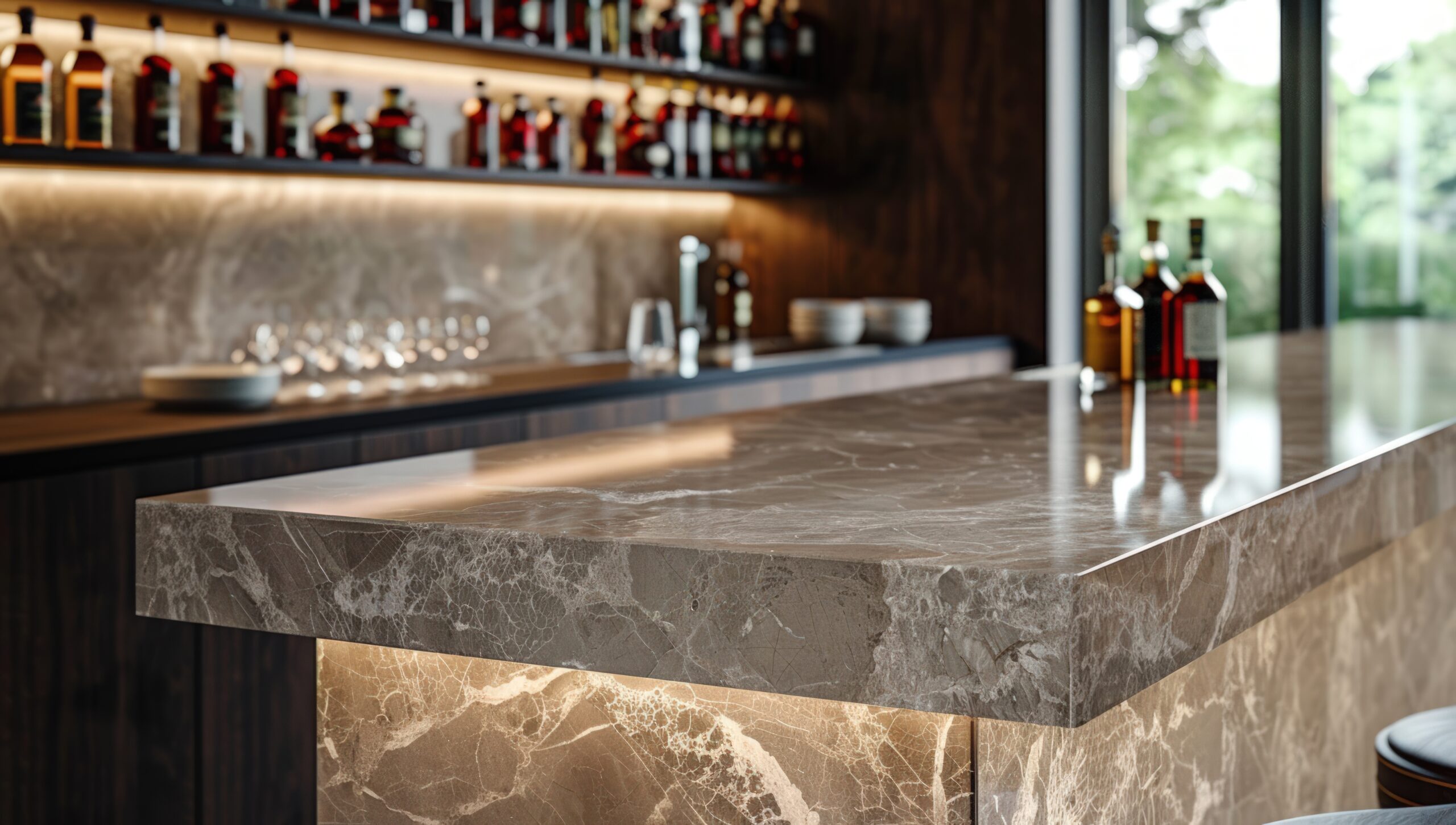
For many years, the worktop has been the last decision in a kitchen design. It was always cabinetry, the colour palette and hardware first, and only then did the stone get picked to complement everything else. However, that thinking has shifted, and the shift has been significant. Today, the most exciting interior designers working across luxury Essex homes are doing the opposite. They are letting the stone lead.
At Modern Worktops, we fabricate quartz, marble, granite, and porcelain worktops for designer-led projects. We have watched the shift in what clients are choosing, and the results speak for themselves. When stone leads a scheme, the whole room reads with more confidence, more cohesion, and more personality. Here is how the best designers are making it work.

The Old Approach vs the New
Historically, the worktop was chosen to fit the kitchen. It complemented the cabinetry, matched the tiles, and echoed the paint. It was often the safest decision in the room. However, the new approach flips that. Designers now choose the stone first, then let its personality dictate the rest of the scheme. As a result, the cabinetry supports the stone rather than competing with it. The brassware picks up its warm tones, the lighting is calibrated to bring its veining to life, and in short, the stone is the foundation.
Starting at the Slab Yard, Not the Paint Chart
When stone leads, the design process starts differently. Instead of gathering cabinetry and paint samples first, designers are heading to the slab yard early in the project. They are bringing their clients with them, because standing in front of a full slab changes the conversation entirely.
That slab becomes the reference point. Its veining sets the palette, the undertones dictate the metals, and its scale suggests the proportion of the island or feature wall. Therefore, every subsequent decision, from cabinet colour to floor finish, is measured against the slab rather than the other way around.
At Modern Worktops, we love this stage of the process. We keep our yard open for designer visits precisely because we know that seeing stone in real life is where the best design decisions get made.
Letting Veining Dictate the Palette
Here is where stone-led design really starts to sing. A slab of Calacatta with warm golden veining naturally pulls the scheme towards soft creams, brushed brass, and warm oak. A dramatic Arabescato with cool grey movement leans into crisp white, polished nickel, and cooler-toned cabinetry.
Furthermore, the veining itself becomes the artwork. Designers are pairing bold stone with intentionally quiet cabinetry so the slab has room to breathe. As a result, the eye is drawn exactly where the designer wants it to go.
Porcelain worktops offer the same opportunity. Large-format porcelain with dramatic patterning gives designers a piece of architectural art to build around, especially in contemporary schemes where the finish reads almost like a canvas.
Repetition as a Design Language
When stone leads, it does not stop at the kitchen. Increasingly, designers are running the same stone (or the same stone family) through multiple rooms to create a genuine through-line across the home.
The same marble that anchors the kitchen island might reappear on the utility worktop, the pantry, the master bathroom vanity, the drinks bar, and even a fireplace hearth. Consequently, the home reads as one continuous story rather than a collection of separate rooms.
Designers are using tonal variations of the same stone family across a project. A bolder Calacatta in the kitchen. A softer Statuario in the bathroom and a honed marble in the study. The stone becomes a visual signature that ties the whole scheme together.
Scale as a Statement
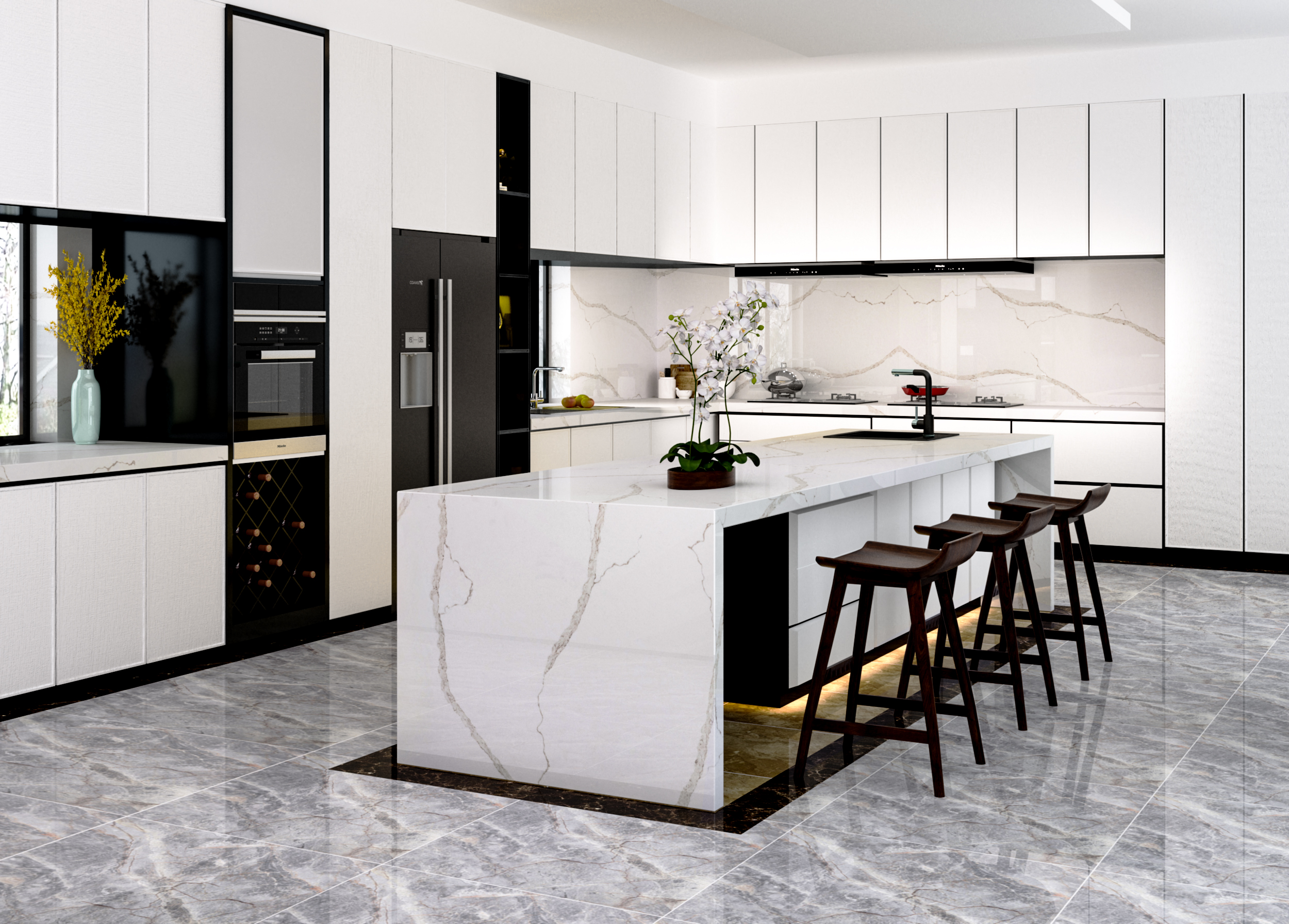
When stone is the lead, scale matters. Designers are specifying oversized slabs for islands, waterfall edges that flow uninterrupted, and full-height splashbacks that carry the veining up the wall behind the hob. Mitred edges with a perceived thickness of 40mm or 60mm are used to make the stone feel monolithic and considered.
Book-matched veining is another way designers are celebrating stone as the hero. Two slabs mirrored across a splashback or island create symmetry that feels almost sculptural. As a result, the stone stops being a surface and starts being a feature.
When Bold Stone Meets Quiet Design
One of the most elegant expressions of stone-led design is the pairing of a bold slab with deliberately restrained everything else. For example, simple, flat-fronted cabinetry, neutral walls, understated brassware and no competing patterns anywhere in the room.
This approach lets the stone do all the heavy lifting. So a single, well-chosen slab of Calacatta Viola or a richly veined granite can define an entire kitchen without another statement piece. It is confident design at its most refined.
The Practical Case for Leading with Stone
Beyond the aesthetics, there is a practical reason this approach works so well. Stone has a longer lead time than most other kitchen finishes. Slabs need to be reserved, templated, fabricated, and installed with precision. So choosing it early gives the whole project more breathing room.
Once you have chosen the stone, sourcing everything else becomes easier. You can finalise the cabinetry against the veining, paint colours can be matched to the undertones and brassware, tapware, and lighting all have a clear reference point. In other words, leading with stone is not just beautiful. It is efficient.
Cohesion Beyond the Kitchen
Designers leading with stone often continue the language beyond the traditional worktop areas.
- Book-matched marble of a fireplace surround
- Porcelain cladding on a media wall
- Quartz vanities that echo the kitchen island
- Granite worktops in the pool house bar that tie back to a granite hearth in the living room
Bespoke stone furniture is becoming a signature move.
- A dining table cut from the same slab family as the kitchen island
- A stone coffee table that references a bathroom vanity
- Stone-topped consoles in the hallway
Continuing the stone through the home reads as a considered design, not a set of rooms assembled from separate decisions.

Related blogs:
Beyond the Kitchen: Stone Applications Designers are Exploring in Luxury Homes
Managing Client Expectations on Natural Stone: A Designer’s Guide
Why Local Matters: The Advantage of a Fabricator Who Knows Your Area
From Mood Board to Slab: Working with Designers to Bring a Vision to Life
The Quartz Worktops Trending in Essex Luxury Homes Right Now
If you are working on a luxury project, we would love to be part of it from the start. Get in touch to arrange a slab yard visit, request samples, or talk through a stone-led scheme with our team. After all, the best luxury interiors are the ones where the stone does not follow the design. It leads it.